¶ Definition The Calculated Take-Off Time (CTOT) is the departure time slot also known as ATFM departure slot (air traffic flow management). The departure time slot is the time interval within

¶ Definition
The Calculated Take-Off Time (CTOT) is the departure time slot also known as ATFM departure slot (air traffic flow management). The departure time slot is the time interval within which the take-off has to take place. The departure slot is defined to improve the traffic flow and avoid to jam-up the airspace.
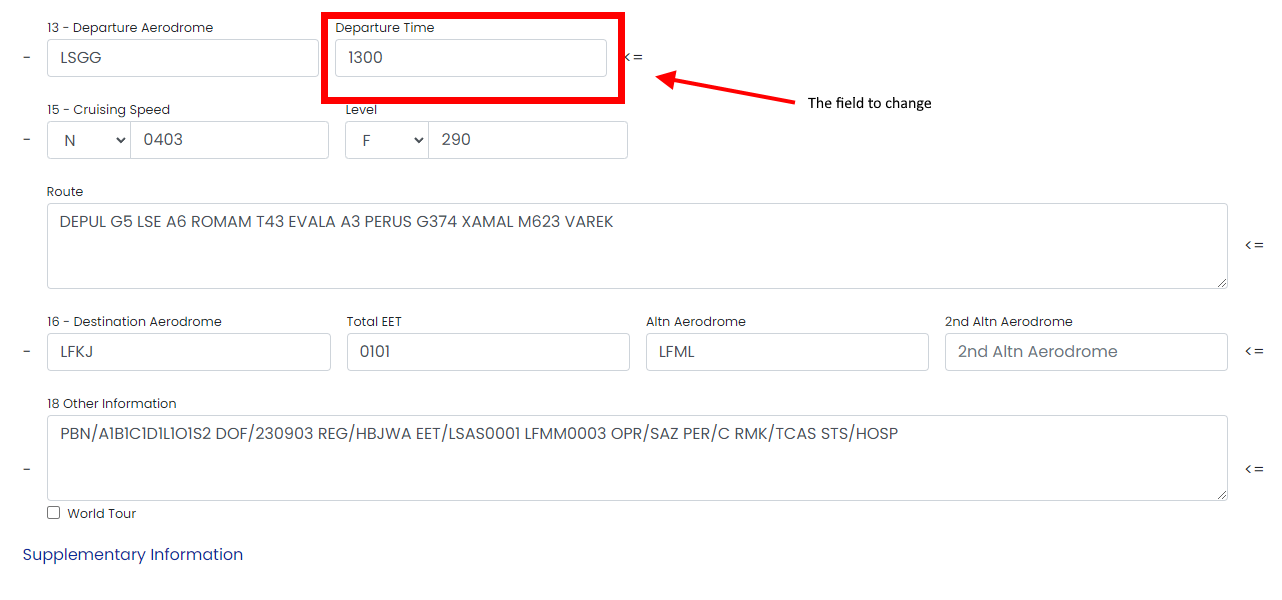
Actually, on IVAO, if a pilot cannot comply with the CTOT, he must update the flight plan, that is, change his EOBT
The pilot has to edit his flight plan himself, by changing the EOBT (Estimated Off Block Time) and send the flight plan back.
This is not ATC’s responsibility. The system will automatically recalculate a new SLOT (CTOT). There is no need to contact ATC to obtain a new CTOT.
It’s important to understand that in real life and on IVAO as well with some big events, the ATC is not the one who assigns the SLOTS (CTOT). In real life, in Europe, the CTOTs are already calculated by Eurocontrol. On IVAO, the CTOT have already been assigned by a SLOT booking system, for example.
¶ Regulation
¶ General rules
Unless specific circumstances require application of a different priority rule, the controller shall allocate departure slots in accordance with the first-planned first-served principle (all the flights entering the regulated airspace are sequenced in the order they would have arrived in the absence of any restriction).
The circumstances that require different priority rules include :
- exclusion of certain traffic flows that enter but do not reduce the capacity of the location of the measure
- exclusion or forcing of specific flights in order to reduce excessive individual delays and optimise the use of capacity
- exclusion and prioritization of specific flights that are not able to benefit from rerouting measures due to overflight permissions or similar constraints
The following flights are exempted from ATFM measures:
- flights carrying Heads of State (or equivalent status);
- flights engaging in fire fighting
- flights conducting search and rescue operations;
- flights for life critical medical emergencies evacuations
- flights approved for exemption from ATFM measures by the appropriate ATS authority
- STS/ATFMX
Where a flight is subject to an ATFM departure slot, that slot is included as part of the air traffic control clearance. Controllers (local ATFM units) shall be responsible for slot compliance monitoring within their area of responsibility.
¶ Controller rules
Controllers shall be responsible for slot compliance at departure aerodromes:
– a slot tolerance is a window of time around a CTOT available to ATC which the aircraft must not depart outside
– ATS units shall provide all possible assistance to operators to meet ATFM slots or to coordinate a revised ATFM slot
In Europe, the departure slot is defined by Eurocontrol with a time tolerance of -5 minutes and +10 minutes around the CTOT.
In America, the CTOT is issued by the ATCSSC (Air Traffic Control System Command Center) using very similar procedures.
For example, if the assigned CTOT is 10h15, the aircraft cannot take off before 10h10 and after 10h25
The system automatically suspends a flight plan when, considering the time tolerance, the ATFM departure slot cannot be met and a new estimated off-block time is not known.
¶ In practice for IVAO
We said that in real life, in the event of a problem, the EOBT was automatically recalculated and a new CTOT generated.
On IVAO, no organization manages your flight plan, so it’s up to you to change the EOBT. But only change the EOBT if you’re 100% sure you won’t be able to meet the CTOT!
If, for example, you encounter a problem with: refueling time, boarding, radio, electronics, engine, hydraulics, etc. In short, problems that can take a long time to solve, such as simulator problems as well, you can think about changing your CTOT.
If the pilot can meet the CTOT, he should not touch the EOBT
Because if a pilot changes his EOBT while still being able to comply with the CTOT, the system will have to recalculate everything, resulting in worse CTOTs.
¶ Use of CTOT on IVAO
On IVAO, the departure slot assignment is mostly used in the case of large events. In these cases CTOT are issued in order to avoid that too many people connect at the same time, which can induce long waiting time for taking off and even large delay at the arrivals.
Several cases may be envisaged:
- In the case of a specific event, a booking form is available on the internet site of the event. Each booked flight is associated with a CTOT and the controllers must respect the CTOT list generated over the whole booking phase.
- In the case of heavy load on a platform, the controller may issue a CTOT to help the regulation of departures.
As is the case in real life, priority is given to pilots with an assigned CTOT and who are able to comply.
If the pilot is ready on time, ATC must handle the traffic in order to make the aircraft taking off within the assigned time slot.
- VID 150259 – Creation
- VID 446375 – Update
- VID 531824 – Wiki Integration
- VID 496402 – Wiki.js integration
- VID 514786 (TDM) – Updated
https://wiki.ivao.aero/en/home/training/documentation/Calculated_take-off_time
Author