, GARLA (Gross Anatomy, Radiology, Living Anatomy) is one of the components of the Structure block that stretches longitudinally across the first two …

Gross Anatomy, Radiology, and Living Anatomy (GARLA)
GARLA (Gross Anatomy, Radiology, Living Anatomy) is one of the components of the Structure block that stretches longitudinally across the first two years of medical education at Case Western Reserve University School of Medicine.
Structure integrates basic and clinical concepts of GARLA and Histopathology. An understanding of these disciplines forms a framework for understanding the basic mechanisms that underlie health and disease. The overall learning objectives of this longitudinal block are to develop an understanding of macro-, micro-, and ultramicroscopic human structure, nomenclature, imaging techniques, basic physical examination skills related to these structures, and their respective functions in normal and diseased organs, tissues, and cells. We attempt to provide opportunities for students to apply and view the material we cover as they would in a clinical setting.
The knowledge of normal gross and microscopic anatomy, as well as imaging (radiology) of these organs and tissues, is necessary for an appreciation of the relationships between altered structure and disturbed function as well as a foundation to understand the anatomical basics of physical examination skills. Thus, Structure bridges the normal and diseased, and begins to prepare students for the transition from classroom to ward.
GARLA begins in the first block titled, “Becoming a Doctor”, with a peer-led introduction to anatomy and radiology. Second-year students meet weekly with small groups of first-year students and discuss and discover the foundations of the basic concepts underlying these disciplines.
Intervening between the first two blocks is a two-week dissection Boot Camp. During Boot Camp, groups of four students dissect one body cavity (either thorax or abdomen) and one limb (either upper or lower limb) and present that material to their peers who dissected the other region. There are formative and summative assessments at the end of weeks 1 and 2 respectively. The Boot Camp culminates with a body donor memorial service where students and donor families gather to recognize the contributions of our donors.
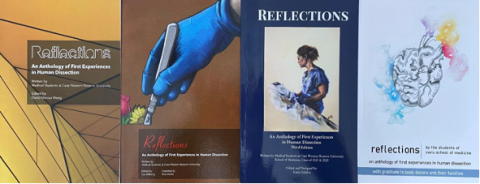
After their first dissection, students are asked to write a reflection about their “first cut” experience, and approximately every second year a Reflections an internal, peer reviewed book is published by the medical students. These books are distributed to the donor families at the memorial service.
3-part GARLA Curriculum
After the Boot Camp, the students begin the 3-part GARLA curriculum which is integrated with the rest of the medical school’s WR2 curriculum . In each GARLA session, students focus on a single theme while rotating through three sessions: Virtual Gross Anatomy, Radiology, and Living Anatomy.
Virtual Anatomy Lab
In the virtual anatomy lab, students use HoloAnatomy to review the anatomy and neuroanatomy associated with the theme of the day. HoloAnatomy is a mixed reality anatomy application created by a team of anatomists, artists, computer programmers and instructional designers at Case Western Reserve University. It includes a library of digital 3-D Anatomy Art with of over 9,000 anatomical asserts. Each lesson is custom-made to focus on the day’s topic. HoloAnatomy expands upon our cadaver-based teaching practices.
Our research has found that our medical students learn as well with HoloAnatomy as they do in the cadaver lab but with less time invested. This has enabled us to integrate equal amounts of radiology and physical exam and ultrasound in every GARLA session.
Garla family crest and coat of arms
The origin, meaning and history of the Garla family name. First page sent by email.

We’ll send your free info and tips to find out more
Thank you! We’re working on your report and will email it within 24 hour.(Please submit this form only once)

Search coat of arms
Search Now
Great news! We have records that match your name. Choose your product below, add a name and we’ll ship your crest in as little as 24 hours.
Yes! We have records that match your family name. To get started, add a product below and start customizing!
Meaning of the Garla family crest symbols

Star
The star symbolized the noble and good qualities of family members, such as loyalty, kindness, and respect. It was also used to represent the belief that additional divine characteristics were granted to family members by a higher power.

Weapon – Arrow
The arrow signifies the early family’s readiness for battle and affliction when threatened. It stands as a testament to family member’s success during times of war and a warning to those we may cross them.
Meaning of the Garla coat of arms colors
Silver
The silver or white color on the coat of arms, (known as ‘Argent’), signifies sincerity and peacefulness. It is one of the oldest colors known in ancient heraldry.
Red
The red color (known as Gules) traditionally symbolized martyrdom and the historic military strength of family members when called upon in times of war.

Garla name meaning and origin
The family name Garla is believed to have origins in Eastern Europe, particularly among Slavic communities. It may signify a connection to various regions or occupations, reflecting a lineage tied to cultural traditions and historical roots. Garla represents a rich heritage and familial bonds.
History of family crests like the Garla coat of arms
Family crests and coats of arms emerged during the Middle Ages, mostly in wider Europe. They were used as a way to identify knights and nobles on the battlefield and in tournaments. The designs were unique to each family and were passed down from generation to generation. The earliest crests were simple designs, such as a single animal or symbol, but they became more elaborate over time. Coats of arms were also developed, which included a shield with the family crest, as well as other symbols and colors that represented the family’s history and achievements. The use of family crests and coats of arms spread throughout Europe and became a symbol of social status and identity. They were often displayed on clothing, armor, and flags, and were used to mark the family’s property and possessions. Today, family crests and coats of arms are still used as a way to honor and celebrate family heritage.
Garla name variations and their meaning
Garla has given rise to several intriguing variations across different cultures and languages, reflecting both phonetic shifts and regional adaptations. In the 17th century, the name emerged as Garle in Spain, influenced by the phonetic tendencies of the Spanish language, where consonant softening often occurs. By the 18th century, the Italian variation Garlini began to surface, embodying the common practice in Italy of adding diminutive suffixes to denote affection or familiarity. During the same period in Eastern Europe, particularly in Poland, the name transitioned to Garlowski, incorporating the characteristic Slavic suffix that signifies belonging or origin. As the 19th century brought forth waves of immigration, variations like Garlauskas appeared in Lithuanian communities, adapting to local naming conventions while maintaining an echo of the original name. Each transformation not only showcases linguistic evolution but also highlights cultural exchanges that shape how names resonate across generations.
Find your family crest
- Get your official family crest here.
- Learn about heraldry at britannica.com
- See an introduction at wikipedia.com
https://case.edu/medicine/curriculum/curriculum-overview/foundations-medicine-health/gross-anatomy-radiology-and-living-anatomy-garla
Author